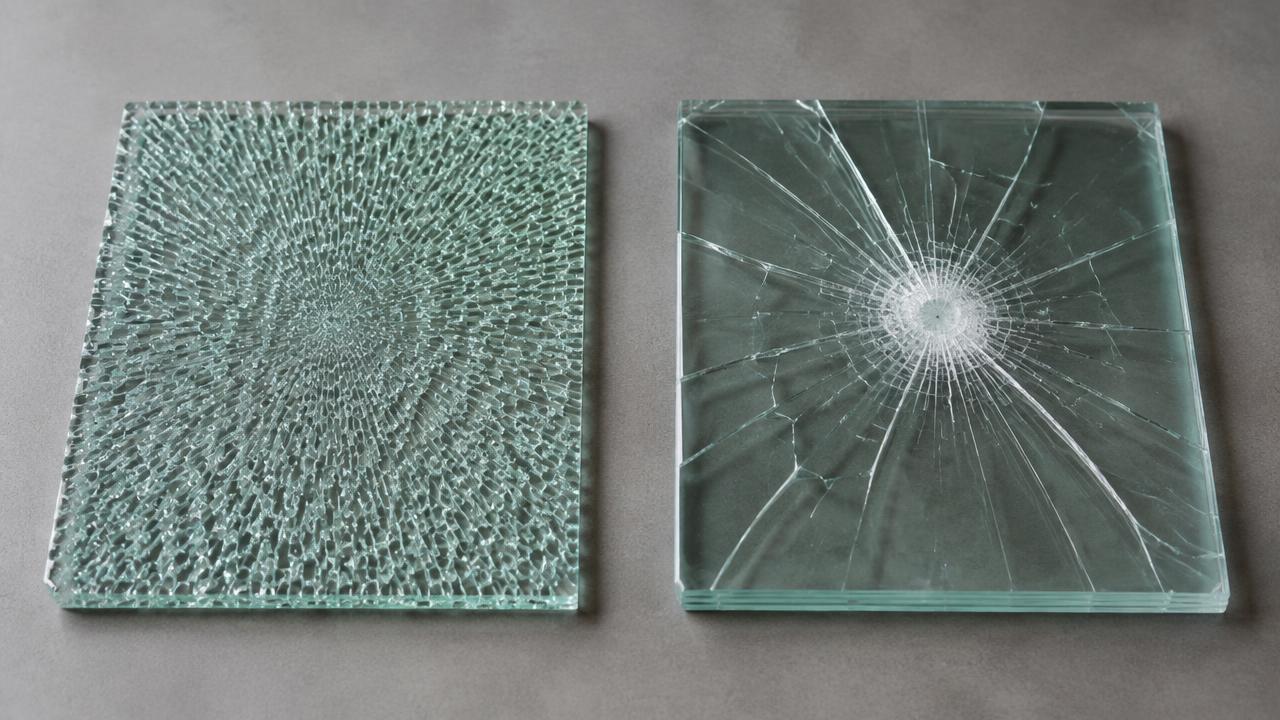
Both are safety glass, and both are far stronger than ordinary annealed glass — but they fail in completely different ways, and that difference decides where each belongs.
Tempered glass
Heat-treated so the surfaces are in compression. It's several times stronger than standard glass and, when it does break, it shatters into small blunt pieces rather than shards. That's why it's the default for shower enclosures, patio doors and glass in and around entrances.
The trade-off: once it breaks, the whole panel is gone instantly and the opening is wide open. Tempered glass also cannot be cut or drilled after treatment — every hole and cut-out is specified before manufacture.
Laminated glass
Two panes bonded to a plastic interlayer. Break it and the fragments stay stuck to the interlayer, so the panel holds together in place. That makes it the better choice where you care about the opening staying closed: overhead glazing, security-sensitive storefronts, and anywhere sound reduction or UV control matters.
Choosing between them
- Shower doors and enclosures: tempered
- Patio and entry door lites: tempered, or laminated where security is a priority
- Storefront glass with a history of break-ins: laminated, or laminated over tempered
- Overhead or sloped glazing: laminated
- Sound issues on a busy street: laminated
One more consideration: spontaneous breakage
Tempered panels can very occasionally break with no impact, from a nickel sulphide inclusion in the original glass. It is rare, but it is a reason some commercial specifications favour laminated in high-traffic locations.